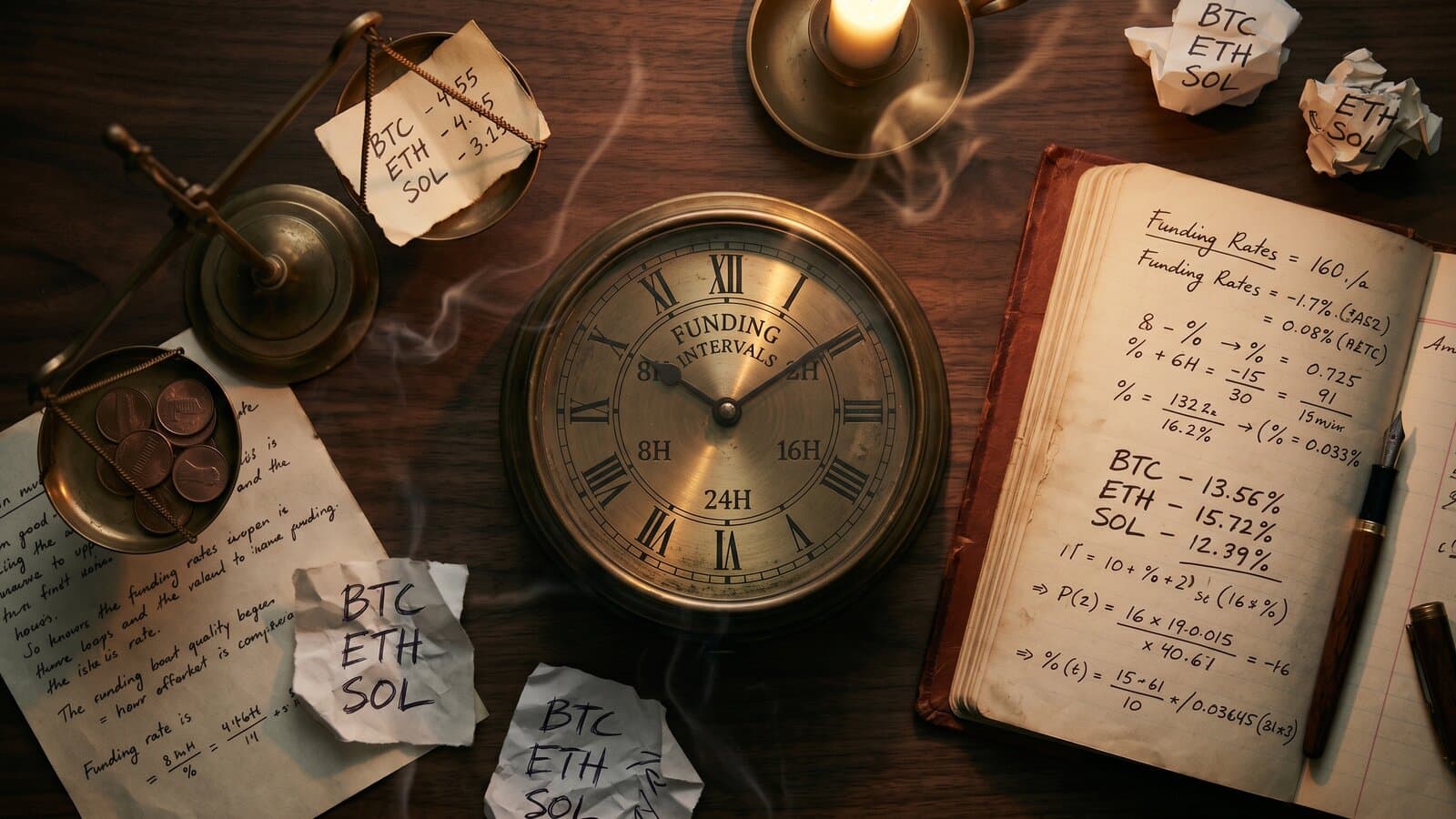
Funding rate is the periodic payment that longs and shorts on a perpetual futures contract send to each other every eight hours. A positive rate means longs are paying shorts; a negative rate means the opposite. It is more than a fee — it is the cleanest real-time reading of how lopsided crowd positioning has become, and extreme values almost always cluster around local tops and bottoms.
What it is — a recurring payment between longs and shorts on perpetual swaps that anchors the contract price to spot. The sign tells you which side is paying.
Why it matters — extreme funding values almost always coincide with local tops and bottoms. Not a prediction; a tell that one side is overheated and bleeding.
How to use it — never alone. Always with the liquidation map and price action. See how Moami's Risk Manager agent reads funding for you.
interval on most venues
BTC funding rate
is paying real money
at 0.1% per 8-hour period
What's inside
- What funding rate actually is
- How the rate is calculated
- 5 signals you can read at a glance
- 4 funding scenarios you'll see
- 3 ways disciplined traders use it
- The pendulum effect — why extremes mean-revert
- Common mistakes
- Funding vs Open Interest
- When the funding signal lies
- Pre-trade checklist
- Frequently asked questions
What funding rate actually is
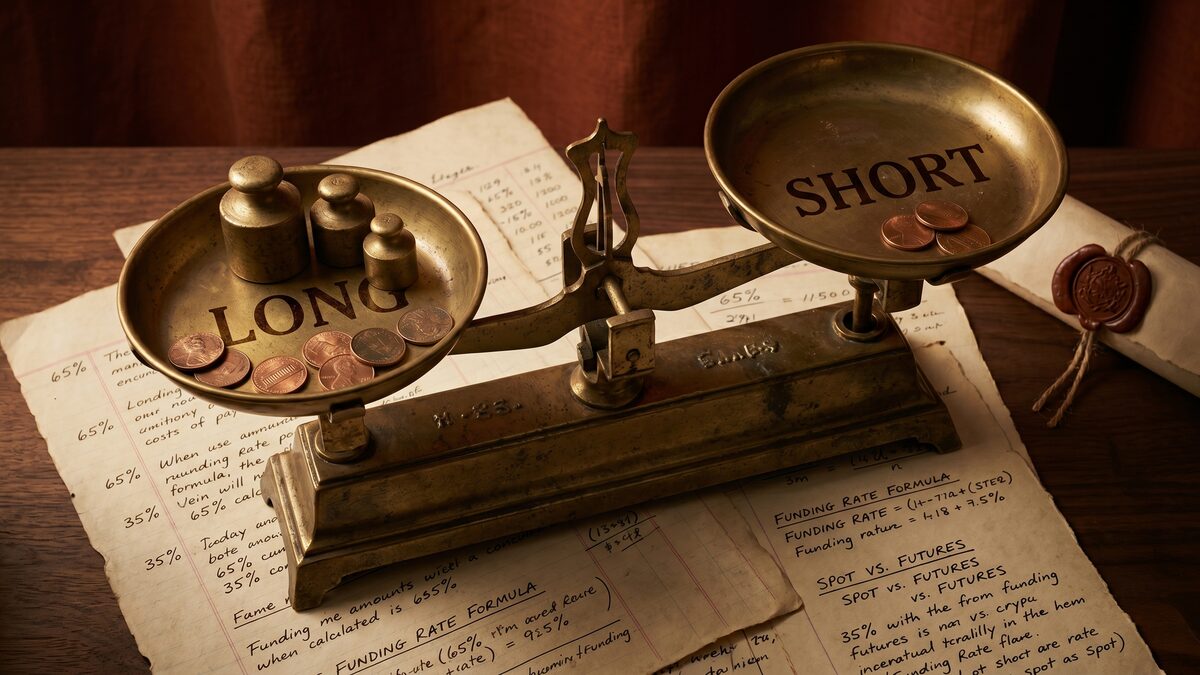
Perpetual swaps don't expire. That is a problem, because there's no settlement date to drag the contract price back to spot. Exchanges solve it with funding: every eight hours, one side of the market pays the other a small percentage of position notional. When the perp trades above spot, there are too many longs and they pay shorts. When it trades below, shorts pay longs.
The amount tracks the imbalance. The wider the gap between perp and spot, the higher the rate, and the more expensive it is to stay on the overheated side. This is self-regulating by design: high funding pushes some traders to close, and arbitrageurs to take the opposite side until the perp price collapses back into spot.
Every major venue publishes the rate: Binance, Bybit, OKX, Bitget, Hyperliquid and Coinbase Advanced. Most show a live predicted rate plus the settled rate at the end of each 8-hour window. Rates differ across exchanges — that is both an arbitrage opportunity and a trap for the inattentive.
How the rate is calculated
The formula is roughly the same on every venue, with small coefficient tweaks. Funding rate has two components: a premium and an interest-rate piece.
funding_rate ≈ premium_index + clamp(interest_rate − premium_index, ±0.05%)
Premium index is the TWAP gap between the perp price and the spot index over the most recent hour. Interest rate is the baseline money-market cost between the fiat and crypto sides of the pair, usually 0.01% per 8 hours. Each exchange averages premium index across multiple snapshots and applies a hard cap. Binance caps the rate at ±0.75%, Bybit at ±0.5%, OKX at ±0.375%.
Settlement happens at the close of the 8-hour window. If you open a position one minute before settlement, you pay (or receive) the full rate. If you close one minute before, you pay nothing. That timing quirk creates the well-known "funding sniping" tactic — more on that below.
Not every venue runs on an 8-hour cycle. Hyperliquid settles funding hourly, dYdX hourly, Coinbase Advanced hourly with a daily smoothing. That means a direct "Binance funding versus Hyperliquid funding" comparison is meaningless without normalising to the same period. Compare annualised values, or compare equivalent time windows — not the raw numbers exchanges display.
What most dashboards show in real time is the predicted funding rate — an estimate based on premium already accumulated within the current window. The number that actually settles can be different: price may reverse and squeeze the imbalance back. Never confuse predicted funding with the settled rate, especially if you're timing entries around the payment.
5 signals you can read at a glance
- The sign. Positive means longs are paying — bullish bias. Negative means shorts are paying — bearish bias. The sign alone is a sentiment map.
- The magnitude. 0.01% is normal. 0.05% is hot. 0.1% or higher is extreme — that side is paying over 100% annualised just to hold leverage.
- Persistence. A single 0.08% reading is noise. Three readings in a row at 0.08%+ is a structural sign of overheating.
- Cross-venue spread. If Binance shows +0.08% while Bybit prints −0.02%, the two venues are seeing a different market. That's an arbitrage signal, not a directional one.
- Divergence from spot. Spot grinding higher while funding goes negative? Institutional shorts are accumulating. That divergence matters more than the absolute reading at any single point.
4 funding scenarios you'll see
| State | What it shows | What usually happens next |
|---|---|---|
| Funding at zero | Steady ±0.005% for several days. No real imbalance. | Range or the start of a new trend. Prepare a thesis, but don't trade funding here. |
| Warm positive | 0.01–0.03% for several periods. Longs confident, not euphoric. | Healthy uptrend. Funding gets paid and the move continues. |
| Extreme positive | 0.08%+ holding for 2+ periods. Longs paying through the nose. | Local top is near. A 3–8% flush typically resets the imbalance in 24–48 hours. |
| Deep negative | −0.05% or lower. Shorts crowded, paying longs. | Setup for a short squeeze. Any upside impulse can trigger a cascade. |
3 ways disciplined traders use it
-
Counter-trend trade on extremes
Wait until funding reads above 0.08% (or below −0.05%) for at least two consecutive periods. Add a second signal: a liquidation cluster on the overheated side, or weakening momentum on the 1-hour chart. Enter against the crowded side, with a 2–4% take-profit and a stop just past the most recent swing high or low.
-
Cash-and-carry basis trade
When funding has been steadily positive at 0.05% or higher, run a market-neutral pair: long the spot, short the perpetual at the same notional. You collect funding every 8 hours with no directional exposure. Works best in ranging markets, demands capital on both legs, and requires monitoring the spread plus borrow costs.
-
Funding sniping (timing tactic)
Close your long a few minutes before the funding payment if the rate is heavily positive, then re-open immediately after. Saves the payment but introduces slippage and the risk of missing the move. Only viable on liquid pairs at sizes that justify the extra round-trip fees.
Practical tip. Compare the current reading to its 30-day range, not to abstract "norms". On BTC, 0.03% can be normal; on memecoins, +0.1% is routine. Look at percentiles, not absolute numbers.
The pendulum effect — why extremes mean-revert
Extreme funding is not magic, it's arithmetic. When longs pay shorts 0.1% per 8 hours, that's 0.3% per day, roughly 109.5% annualised — just for the right to hold the position. Every day the market refuses to move in the long's favour, the long either pays more or gets out. A meaningful fraction always gets out. That is the structural downward pressure: not "the crowd is wrong" but "the crowd physically can't pay forever".
Institutional players know this arithmetic and step into the other side. They short the perp against a spot hedge to harvest funding, or wait for the imbalance to peak and lean into a reversal. When they do it in size and in concert, a local top can form in a matter of hours rather than days.
Let an AI team read funding for you
Paste a position or ticker. Moami's Risk Manager and Market Analyst agents compare the current rate to its historical range, cross-reference open interest and the liquidation map, and return an explanation in under thirty seconds — never a prediction.
Common mistakes
Shorting just because funding is high. A strong trend can hold extreme funding for weeks. Bitcoin in March 2024 ran 0.05–0.1% for more than two weeks while still rallying another 30%. One signal does not make a trade.
Ignoring cross-venue dispersion. If Binance shows 0.08% but Hyperliquid shows 0.01%, you're not looking at the market — you're looking at a Binance-specific imbalance. Treating it as a global signal is a mistake.
Confusing funding with a fee. Funding is a payment between traders, not a cut for the exchange. On a sizable position held for days, it can dwarf spreads and commissions combined.
Forgetting the payment clock. Opening a position 30 seconds before settlement charges you for the full 8 hours you never held. At size, that's real money.
Funding vs Open Interest
- The sign of the imbalance — who is paying and who is receiving.
- The magnitude in percent — exactly measurable pressure on the crowded side.
- Sentiment durability — three persistent periods weigh more than ten sharp candles.
- Cross-exchange picture — divergence between Binance, Bybit and OKX often leads price.
- Position size — that's what Open Interest is for. Funding can spike on thin markets.
- Liquidation levels — for those, you need the liquidation map.
- Spot flow — funding says nothing about actual coin buying or selling.
- Entry timing — even a textbook counter-trend setup can mean-revert tomorrow, not now.
When the funding signal lies
On major catalysts. ETF approvals, halvings, big listings — fundamentals override any funding signal. Fading a real catalyst is the most expensive way to learn the lesson.
During tail-risk news. Regulatory shocks, exchange exploits, fund liquidations — the rate updates an hour after the move has happened. Funding is a snapshot of past sentiment, not current.
On thin altcoins. +0.3% funding on a token with $5M open interest is two or three whales, not "market sentiment". Treating it as a broad indicator gets you in trouble.
In extreme volatility. When price moves 5%+ in an hour, the perp-spot gap appears instantly but funding only updates every 8 hours. The window between can be visibly distorted.
Pre-trade checklist
Before entering a trade based on a funding signal, run the list. If a single line is unchecked, stay on the sidelines.
- At least 2 periods. One extreme reading is noise. Two or three back-to-back is a structural signal.
- Percentile, not raw number. The reading should sit in the top 10% of the 30-day range. Naked numbers without context are noise.
- Confluence. At least one independent confirmation: a liquidation cluster, a 4H divergence, or an order-book anomaly.
- Cross-venue confirmation. The skew is visible on three top exchanges, not just one. A single-venue spike is local, not systemic.
- Risk ≤ 1%. Counter-trend funding trades fight the prevailing tape. Size so a stop costs no more than one percent of your account.
- Clear invalidator. Know in advance the price level that kills the thesis. Without one, a funding trade turns into "hope versus payment".
Editorial note. Moami AI provides probabilistic analysis — explanations and scenarios, never predictions. Funding rate is one of dozens of signals our agents cross-reference with risk, liquidity and price action to help you make decisions on data.