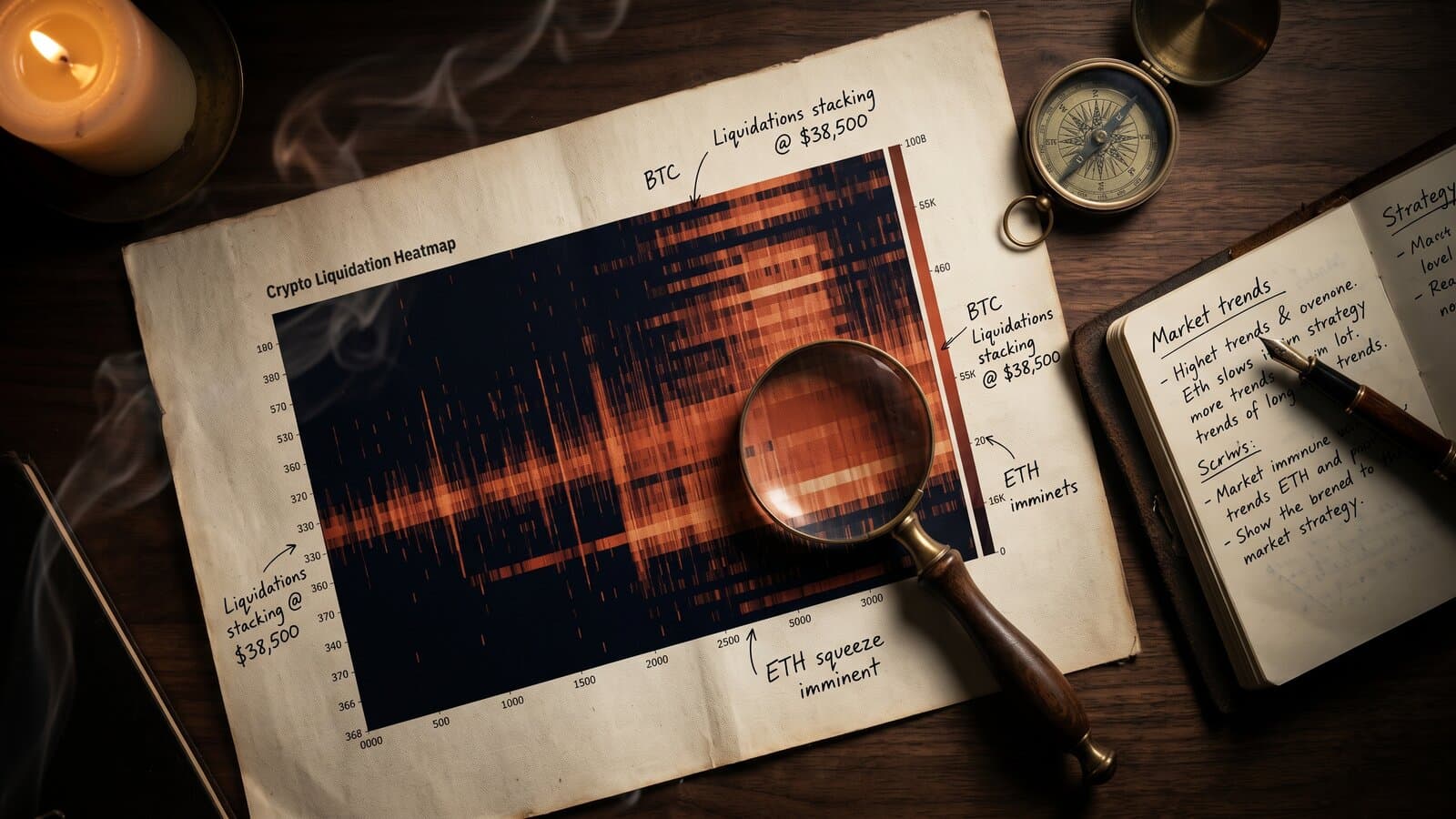
A liquidation map is a real-time visualization of where leveraged crypto positions are most likely to be force-closed. It aggregates pending stop-outs across exchanges into a heatmap so you can see, at a glance, the price levels that act like magnets — zones where price tends to gravitate before reversing. Reading the map well is one of the highest-leverage skills a derivatives trader can develop.
What it shows — a price-by-price snapshot of leverage at risk across BTC, ETH, SOL and most major perpetuals. Brighter clusters mean more capital exposed.
Why it matters — liquidation clusters act like magnets. Market makers see the same map you do, and price often sweeps them before reversing.
How to use it — never alone. Combine with the funding rate, order book depth and price action. Three signals beat one signal every time. See how Moami's Liquidity Expert agent automates this.
on top-2 venues
liquidations
on perps
before any trade
What's inside
- What a liquidation map actually is
- How it's built — the data behind the heatmap
- Five things to spot at a glance
- Four types of liquidation clusters
- Three strategies traders use
- The magnet effect — why price hunts these levels
- Common mistakes
- Map vs order book depth
- When the map lies
- Pre-trade checklist
- Frequently asked questions
What a liquidation map actually is
Every leveraged long has a liquidation price — the level at which the exchange force-closes the position because maintenance margin is no longer satisfied. A 25× long on BTC opened at $100,000 will be liquidated at roughly $96,000. A 50× long at the same entry liquidates at roughly $98,000. Multiply this by tens of thousands of positions across Binance, Bybit, OKX and Hyperliquid, and you get a topography of risk.
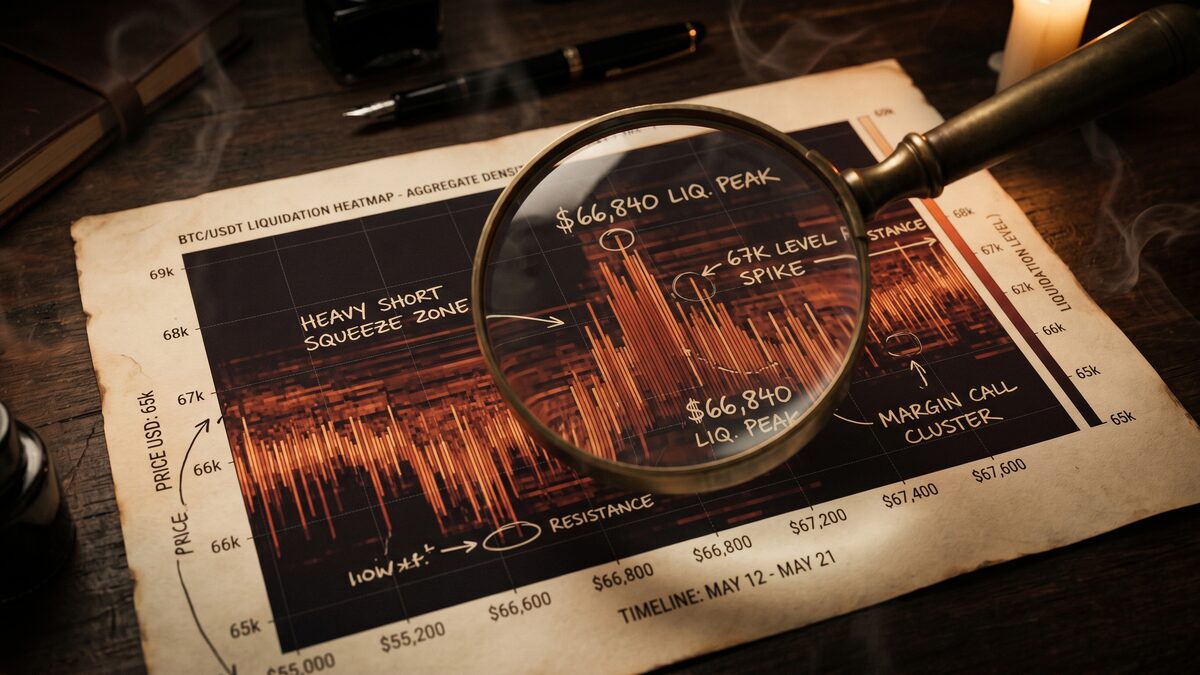
A liquidation map plots that topography. It shows, at every price level, how much leveraged capital sits ready to be force-closed. Bright, dense bars mean a high concentration of stops; dim bars mean little is at risk. The view was popularized by analytics aggregators, and today several independent services and exchanges' own panels show roughly the same picture.
The mental model that matters: leverage is not invisible. It leaves a public footprint, and that footprint attracts price.
How it's built — the data behind the heatmap
The math is openly known. For a long position with isolated margin, the liquidation price is approximately:
liq_price ≈ entry × (1 − 1/leverage + maintenance_margin_rate), with funding rate accrual layered on top over time.
Aggregators pull open-interest data and average leverage estimates from public exchange feeds, model these formulas at every price step (typically 0.5% or 1% increments) and render the result as a heatmap. The newer the data, the more relevant — clusters older than a few days have usually been tested, defended, or exited.
Most maps offer 12-hour, 24-hour, 7-day and 30-day windows. For active trading, the 12–24h view is the workhorse. The 7–30d view is useful for context — it tells you which levels have been ignored versus which have been actively defended.
Five things to spot at a glance
- Density — thicker, brighter bars mean more leverage stacked. A bar 3× taller than its neighbours is a magnet, not noise.
- Asymmetry — more longs sitting above the spot price means downside risk; more shorts sitting below means upside risk. The heavy side is the side that gets hunted.
- Distance from spot — clusters within 1–3% of the current price are imminent magnets. Anything beyond 5% is more of a context marker.
- Freshness — a cluster that formed in the last six hours is much more meaningful than one that has been sitting there for a week without being touched.
- Imbalance flips — when the long/short cluster ratio flips intraday, it usually means the previous side has been partially flushed. The next move tends to hunt whatever is now the heavier side.
Four types of liquidation clusters
| Type | How it looks | What it usually means |
|---|---|---|
| Wall | Tall, narrow column at one price | One large entity loaded at high leverage. Sweeps tend to be sharp and fast — the price wicks through the level and reverses within minutes. |
| Ladder | Step-down series at successive prices | Retail piling in on a trend. When the first step breaks, the cascade triggers — this is what drives "flash" wicks of 3–7%. |
| Symmetric | Long & short clusters of similar size on either side | Indecision. Neither side has structural advantage. Expect chop, range trading and false breakouts until one side dominates. |
| Asymmetric | One side significantly heavier | The clearest setup. The heavy side is the directional bias for liquidation hunts. Combine with order book and funding for a high-quality entry. |
Three strategies traders use
-
Sweep-the-cluster
Wait for price to approach a dense cluster. Watch the order book for sudden liquidity depletion at that level. Enter the reversal after the wick — never in front of it. Stop loss goes on the opposite side of the cluster, not on its near edge.
-
Confluence trade
Wait until a liquidation cluster lines up with at least two other signals: a horizontal support or resistance, a funding-rate flip, and a clear order-book wall on the opposite side. Three confluences turn a guess into a thesis.
-
Avoid-the-magnet
If you're already in a winning position and a major cluster sits between you and your take-profit, take partial profit early. Price almost never pushes through a heavy cluster on the first attempt — expect at least one violent rejection.
Practical tip. Never trade a cluster alone. The map shows where price is attracted, not where it will go. Without confirmation from price action and order book, a cluster is just a hypothesis.
The magnet effect — why price hunts these levels
The reason clusters behave like magnets is not mystical. Market makers and large directional players see the same map you do — and they have inventory to manage. A $50M stack of longs sitting at $96,000 represents $50M of guaranteed market sell orders if the price gets there. That is rare, predictable liquidity. Filling sell orders at $96K is far more attractive than filling them at $94K, so they push.
This is why "stop hunts" are not paranoia. They are a rational response to public information. The map is not a secret; the participants who profit from sweeping it are simply faster, better capitalised, and unsentimental.
See your trade through the lens of an AI risk team
Paste any open or planned position. Moami's Liquidity Expert agent reads the cluster map, order book and funding rate, and reports back in under 30 seconds — alongside the rest of the AI analyst team covering risk, market context and discipline.

Common mistakes
Treating the map as a prediction. It shows magnets, not certainty. A cluster can sit untouched for days and then never be visited at all.
Ignoring time decay. A 30-day-old cluster has been tested, defended, or quietly exited many times already. Recency matters.
Trading every cluster. Most clusters do nothing. Patience is the actual edge.
Not factoring funding. If long funding is at 0.1% per 8 hours, those longs are already paying a fortune. Many will exit before liquidation, and the cluster you see may be smaller in reality.
Liquidation map vs order book depth
- Shows leverage at risk — liquidity that must appear if price gets there.
- Aggregates across exchanges — order books are siloed, the map is global.
- Forward-looking — you see where price could be drawn across the next session.
- Works across timeframes — scalping, swing or position sizing.
- Real, sitting orders right now — only the order book shows that.
- Updates instantly — most public maps lag 1–5 minutes behind reality.
- Spot positions — only futures leverage is captured.
- Manipulation-proof signal — sophisticated players can park fake leverage to bait sweepers.
When the map lies
During cascade events. When a single move triggers more than $1B in liquidations within an hour, the cluster you were watching is consumed in seconds. The map updates after the fact, not before.
In low-volume regimes. Weekends and Asian quiet hours have plenty of magnets but no fuel to reach them. Clusters can sit there for 48 hours undisturbed.
Around major news. Macro releases, ETF flows, and exchange-related rumours override technical magnets. When fundamentals dominate, the map becomes background noise.
At funding-rate extremes. When funding is at the top or bottom of its historical range, the leveraged side is already paying or receiving heavily. Many will close out before the cluster ever triggers.
Pre-trade checklist
Before entering a trade based on a liquidation cluster signal, work through this list. If any item fails, don't take the trade — wait for a better setup.
- Confluence. At least two other signals — order book, funding rate, S/R level or volume — agree with the map.
- Distance. The cluster sits within 0.5–3% of the current price. Closer than that is too late; further is too speculative.
- Recency. The cluster formed within the last 24–48 hours. Older magnets have usually been worked already.
- Asymmetry. Clear bias to one side. Symmetric clusters are noise.
- Risk placement. Stop-loss sits on the opposite side of the cluster — never on the near edge. The wick is the trade, not the threat.
Editorial note. Moami AI provides probabilistic analysis — explanations and scenarios, never predictions. The platform is designed to help disciplined traders make data-driven decisions, not to remove risk from leveraged trading.